
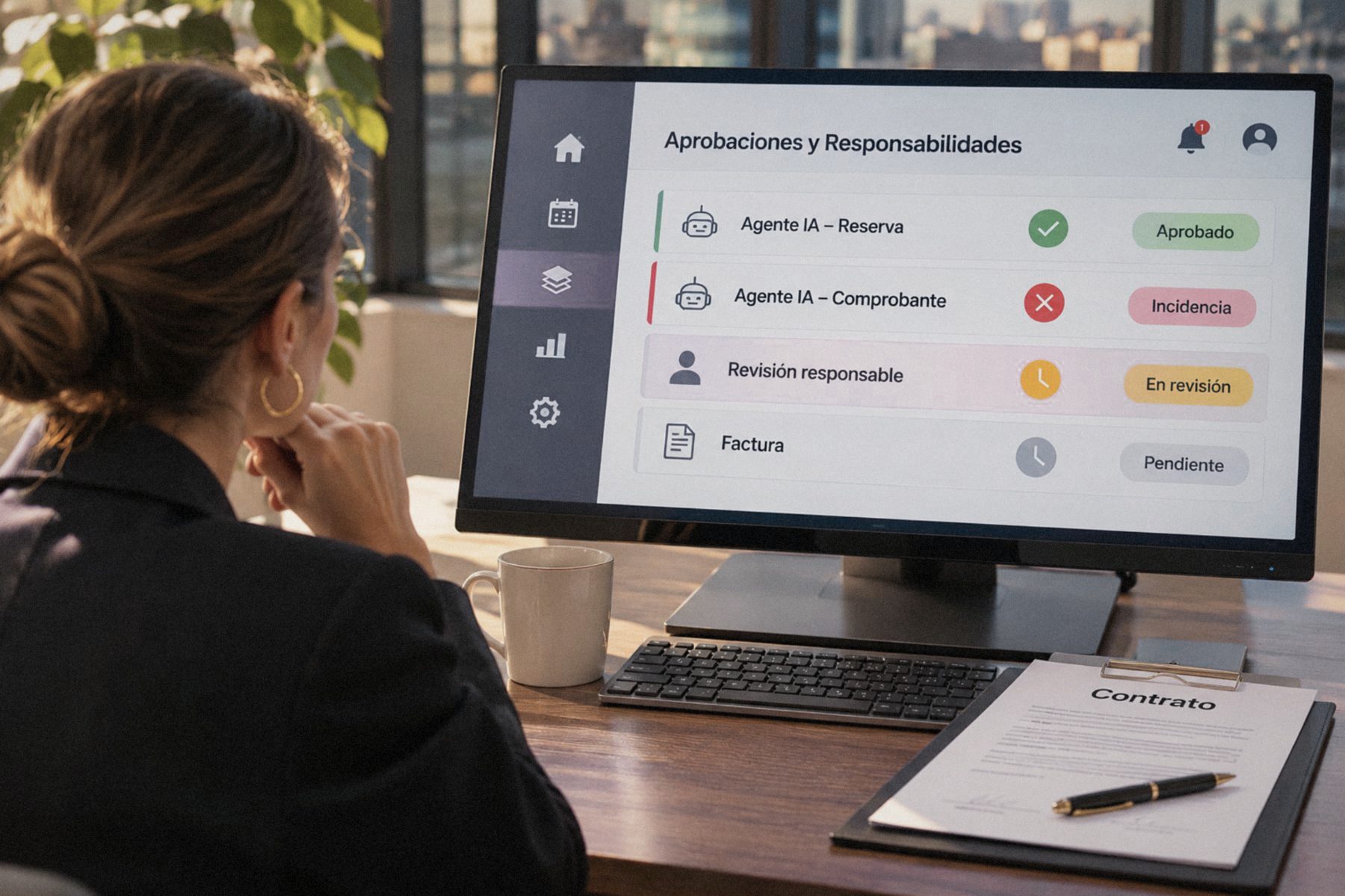
Why the CFO has to approve the agent
AI agents are moving from pilots into operations. In its 2026 survey, McKinsey found that about two in ten organisations are scaling agents across the business, rising to 40% among large companies, up from 27% the year before. The same study notes that the organisations getting the best results from AI are much more likely to be working to prevent unauthorised or unintended actions by their systems.1
In media buying, an agent can negotiate and book faces, as we described in AI agents are already buying screens, which commits the company's or its client's money. For that spending to be as auditable as that of an employee with signing authority, the CFO needs to require five controls.
- Permissions and spending limitsWhat the agent can commit, per Campaign, per supplier and in total, and on whose behalf.
- Segregation of dutiesThe agent that proposes a purchase does not approve it, and nobody sets the limits they will use themselves.
- Full traceabilityEvery action recorded with the rule applied, the data consulted and the person who approved.
- Human review at defined pointsSpecific moments when a person decides, with a real ability to stop or correct.
- Contractual responsibilityWho answers for each error, written into the contracts between advertiser, agency, media owner and technology provider.
Permissions, limits and segregation of duties
An agent should have its own identity in the systems, separate from that of any employee, with permissions limited to its role. That way it is always clear what the agent did and what a person did. Limits are expressed as amounts and conditions: budget per Campaign, maximum amount per transaction, approved suppliers, dates and unit types. The system should check them before every action, regardless of what the agent has decided.
Segregation of duties is the classic control that stops a single person from initiating, approving and paying for a transaction. It applies in the same way to agents. If the agency's agent proposes the purchase, a person or a rule checked by the system approves it. If the agent can confirm orders, releasing payment depends on the agreed conditions being met, such as verified posting. And whoever defines the agent's permissions is a different person from whoever uses it day to day.
AloneWithin the approved rules
- Query inventory, availability and audience data.
- Prepare plans and proposals.
- Negotiate within the approved price and discount ranges.
- Place provisional holds that lapse after a set period.
- Confirm purchases below the set amount, with approved suppliers.
- Validate proof of posting above the agreed threshold.
- Flag issues and deviations.
With approvalA named person decides
- Purchases above the set amount or outside the budget.
- New suppliers or terms different from those agreed.
- Changes to dates, faces or creative in a confirmed Campaign.
- Doubtful proof of posting, deductions for issues and credit notes.
- Cancellations with penalties.
NeverBlocked by the system
- Change its own limits, permissions or rules.
- Onboard suppliers or change their bank details.
- Release payments outside the agreed conditions.
- Approve what it has proposed itself.
- Sign framework contracts or change general terms.
- Delete or alter records.
Traceability of every action
Auditing an agent means reconstructing what it did, why and under what authority. That requires a record that cannot be altered afterwards and that links each action to the Campaign, the contract, the proof of posting and the invoice. If the record is kept in a system separate from the one that runs the Campaign, someone will have to match them by hand at every audit.
Agency buying agentIts own identity, separate from any employee's.
Agency and advertiserWith the mandate and budget they gave it.
Confirm purchase of 12 facesWith details of faces, dates and price.
Buying policy, version 4Amount below the automatic confirmation limit.
Availability and agreed priceAs they stood at the time of the action.
Not required by the ruleIf required, the person's name and time.
Human review at defined points
Human review works when the person has the time, the information and the ability to change the outcome. The EU AI Act describes this in Article 14, written for high-risk systems. Under that article, the person overseeing should be able to understand what the system can and cannot do and monitor its operation, stay aware of the tendency to over-rely on its outputs, interpret them correctly, decide not to use the system or override its output, and intervene or halt it, for example with a stop button.2
A media buying agent is not expressly listed among the high-risk uses in Annex III, and its classification should be confirmed by a lawyer. Even so, Article 14 is a good guide for designing oversight. In practice it means setting the moments when a person steps in, making sure that person sees the reason and the data for each case, and having a way to suspend the agent instantly. It also helps to measure how many proposals are approved without changes: if practically all of them are, the review may have become a formality.
Who is liable: what the law says and what the contract says
In February 2025 the European Commission listed the withdrawal of its proposed AI civil liability directive in its work programme, and confirmed it in July that year.34 The new Directive (EU) 2024/2853 on defective products remains, covering software, including AI, which member states must transpose by 9 December 2026.5 That directive compensates only natural persons, for personal injury, property damage and data loss, and excludes property and data used exclusively for professional purposes.6
In a purchase between companies, then, the allocation of responsibility depends mainly on the contracts. The legal review should cover at least these points:
- Who operates the agent and on whose behalf it actsAgency, advertiser or media owner, and what mandate each one gives it.
- What binds each partyFor example, that only a commitment confirmed in the system and within the agreed rules is binding.
- What happens with an errorA price out of range, the wrong face or a duplicate booking: how it is detected, how it is corrected and who bears the cost.
- What the technology provider is liable forAvailability, agent failures, security and liability caps.
- Access to recordsWho can consult them, how long they are kept and in what format they are handed over in an audit or a dispute.
- SuspensionWho can stop the agent and what happens to transactions in progress.
The regulatory framework as of October 2026
Regulation (EU) 2024/1689, known as the AI Act, applies in phases. In July 2026 the Digital Omnibus on AI was published; it entered into force on 27 July and postponed the obligations for high-risk systems. Those under Annex III, which covers uses such as recruitment or assessing individuals' creditworthiness, move to 2 December 2027, and those for systems embedded in regulated products to 2 August 2028. The same text reframed the AI literacy obligation as a duty to adopt measures that promote it.78
- Prohibited practicesFirst obligations apply.
- General-purpose modelsObligations for providers of these models.
- Omnibus in forcePublished on 24 July; postpones high-risk rules.
- TransparencyArticle 50, with a transition to 2 December 2026 for some systems.
- High-risk, Annex IIISystems embedded in regulated products follow on 2 August 2028.
Two voluntary frameworks help structure the controls. The NIST AI Risk Management Framework, published by the US standards body in January 2023, organises AI risk management into four functions: govern, map, measure and manage. It was supplemented in July 2024 with a profile for generative AI, and the framework is under revision.9 ISO/IEC 42001, published in December 2023, sets out the requirements for an AI management system for any organisation that develops, provides or uses AI-based products.10 Both give the CFO a common language with internal audit and with suppliers, and they complement the legal analysis of each case.
This article summarises the general framework as of October 2026 and does not constitute legal advice. The classification of each system and the content of the contracts should be reviewed by each company's legal advisers.
Where OS.ooh fits
In OS.ooh, each company works with its own roles and permissions, and every Campaign is recorded from proposal to payment, with proof of posting and invoices linked. Payment is held in an escrow account with MoneyToPay, an entity regulated by the Bank of Spain, and released when the agreed terms are met. On that foundation, an agent's permissions, its limits and the points where a person decides can be defined, with a record shared by the parties.
Sources
- McKinsey & Company (QuantumBlack), "The state of AI in 2026: On the road to ROI", 25 August 2026. mckinsey.com
- Regulation (EU) 2024/1689, Article 14, "Human oversight", via activeMind.legal. activemind.legal
- Bird & Bird, "Proposed EU AI liability rules withdrawn", February 2025. twobirds.com
- Euronews, "EU Commission confirms ditching of AI liability and patents proposals", 31 July 2025. euronews.com
- Norton Rose Fulbright, "Revised Product Liability Directive introducing rules on strict liability for AI". nortonrosefulbright.com
- CMS, "The new EU Product Liability Directive (EU) 2024/2853", 13 October 2026. cms.law
- Garrigues, "The AI Digital Omnibus Regulation has been published, redefining deadlines and simplifying requirements for companies and developers", 24 July 2026. garrigues.com
- Secure Privacy, "EU AI Act Digital Omnibus: the new high-risk AI deadlines after Council approval", 10 July 2026. secureprivacy.ai
- NIST, "AI Risk Management Framework". nist.gov
- IEC Webstore, "ISO/IEC 42001:2023 Information technology — Artificial intelligence — Management system", 18 December 2023. webstore.iec.ch