What needs checking in every photo
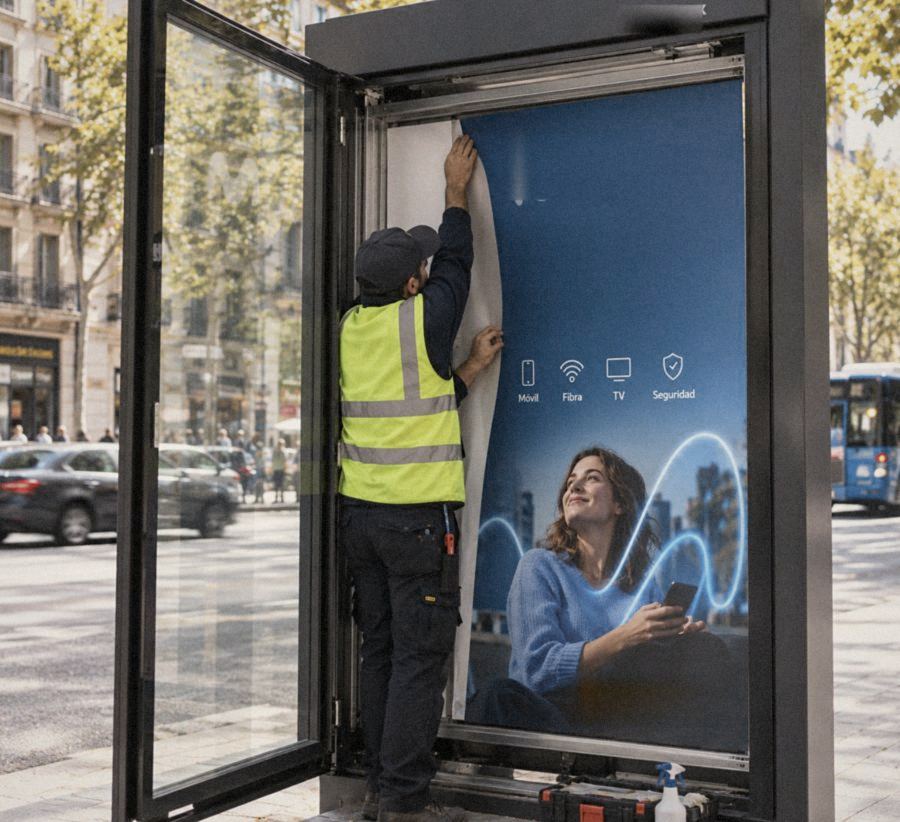
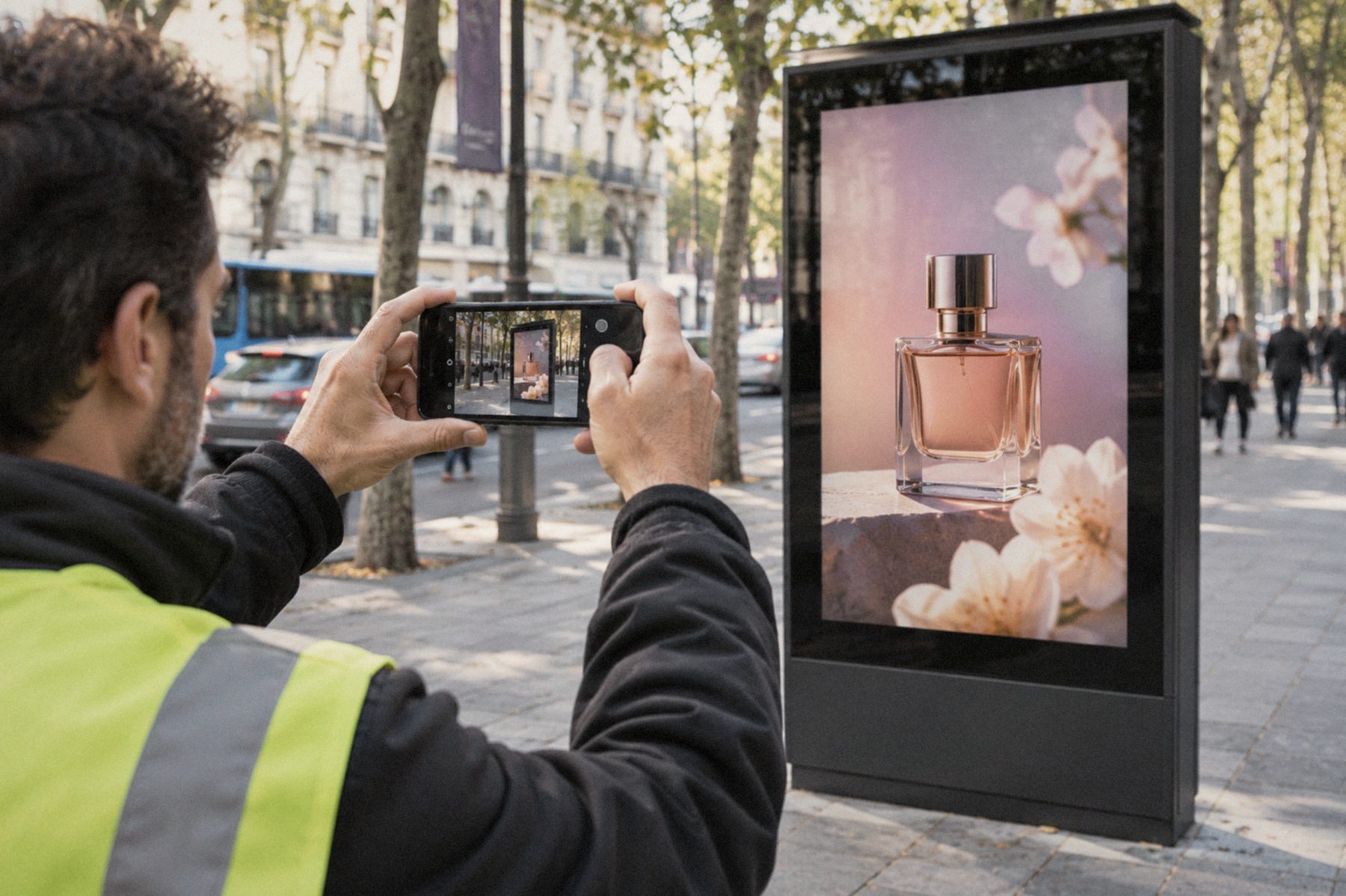
When the agency receives the proof-of-posting photos, someone opens them one by one and checks the same things each time: that the photo is of the booked unit, that it was taken within the Campaign dates, that the creative is the one approved for that face, that the poster is in good condition and that the photo belongs to this posting. That last point matters too, because a photo from an earlier Campaign can slip into the folder by mistake.
In a field check in Italy, almost 10% of the billboards reviewed did not carry the booked ad.6 We cover it in more detail in How does a brand know its Campaign actually ran? When the review is manual and there are thousands of photos, an issue can easily go unnoticed.
Computer vision is the branch of artificial intelligence that analyses images. Applied to proof of posting, it runs these checks on every photo, gives each one a confidence score and sorts the photos into two groups: those that match what was booked and those that need a person to look at them.
Automatic checks
- Photo arrivesTaken in the app, with the face and the Campaign already identified.
- MetadataTime and coordinates compared with the booked dates and location.
- UnitAppearance compared with the reference photo of that face.
- CreativePoster compared with the approved final artwork.
- New photoImage fingerprint compared with every earlier photo.
- ConditionDamage, graffiti, obstructed areas or lighting off.
Outcome
- Everything matchesValidated without intervention and recorded.
- Some doubtGoes to a person with the reason flagged.
- Decision recordedWhat was validated and what was deducted reach the invoice.
How each check works
Location and date. A photo taken on a phone stores metadata: date, time, coordinates and device model. The system compares the coordinates with those of the unit in the inventory and the time with the Campaign period. A phone's GPS is typically accurate to within a 4.9-metre radius under open sky, and accuracy worsens near buildings, bridges and trees.3 On a street with several units in a row, coordinates alone cannot tell which one it is, which is why the visual comparison is needed.
Appearance of the unit. Each face has one or more reference photos in the inventory. The system extracts features from the new image, such as the shape of the structure, the frame, the façade behind it or a nearby lamp post, and calculates how closely they resemble the reference. If the coordinates point to one face and the image looks like another, the photo goes to review.
Creative. The system locates the poster within the photo, corrects the perspective and compares it with the final artwork approved for that face. That is how it detects the wrong creative, an old version or a variant meant for another area. OneVision, a prepress software vendor, launched a tool in 2025 that validates billboard photos with this kind of check together with coordinates and timestamps, and leaves manual review for exceptions.4
Repeated or reused photos. Each image is reduced to a digital fingerprint that barely changes when the photo is cropped, compressed or brightened. By comparing that fingerprint with every earlier photo, including those from other Campaigns, the system finds the same photo submitted twice. Near-duplicate image detection is a well-studied problem in the academic literature, with methods compared in published benchmarks.5
Condition of the unit. A model trained on examples recognises posters that are torn, peeling, covered in graffiti or partly obstructed, and in night photos, whether the lighting works.
| Check | How it is done | Where it fails |
|---|---|---|
| Date and timeWas it taken within the booked period? | ReliableDevice time checked against the time it reaches the server. | Photos uploaded from the gallery hours later, or badly set clocks. |
| LocationIs it where the unit is? | LimitedPhoto coordinates compared with those of the unit in the inventory. | Narrow streets, tall buildings, trees and units very close to each other. |
| UnitIs it the booked face? | LimitedImage features compared with the reference photo of the face. | Roadworks, scaffolding or changes to the surroundings, angles very different from the reference. |
| CreativeIs it the artwork approved for that face? | LimitedPoster cropped, straightened and compared with the final artwork. | Reflections on an urban panel's glass, backlight, night, vehicles or branches in front, near-identical variants. |
| New photoDoes it belong to this posting? | ReliableImage fingerprint compared with the full photo history. | It only detects repeats of photos already in the database; a photo from another source needs other evidence. |
| ConditionIs the Campaign clearly visible? | LimitedModel trained on examples of damage, graffiti and obstructions. | Minor damage, dirt, distant or low-resolution photos. |
Where it is already used
Consumer goods is the sector that has gone furthest, using image recognition to check how its products are displayed in stores. In 2021 Coca-Cola HBC's chief information officer explained that the company used such software for in-store product audits previously done by hand, and that it processed around 900,000 images a month with over 95% accuracy.1 An academic review published in 2020 summarises the technical difficulties of recognising products in images and the methods used to address them.7
Insurers have been tackling reused photos for some time. Verisk compares the photos in each claim against a database of millions of images contributed by participating insurers, reviews their metadata and looks for signs of manipulation. In one of its cases, an insurer uncovered an appraiser who had submitted 170 duplicate photos over two years, on claims worth more than a million dollars.2
In out-of-home, the posting photo as evidence has a long history in the UK. Marketing Week reported that Clear Channel and JCDecaux were preparing live proof-of-posting systems: in Clear Channel's, operators scanned a label on the poster with a phone and photographed any damage, and in JCDecaux's, staff photographed each Campaign when posting it and uploaded the images to a portal. Clear Channel aimed to cover all its UK panels by March 2008.8 Today Outsmart, the UK out-of-home media owners' association, still lists static proof of posting among its outstanding work.10
Images a month processed by Coca-Cola HBC in its store audits in 2021.
Accuracy the company reported for that image recognition.
Duplicate photos submitted by an appraiser over two years, uncovered in a Verisk case.
Billboards without the booked ad in a check of fifteen Campaigns in Italy (2016).
Why doubtful cases stay with a person
Even with high accuracy, volume makes errors add up. As an example with round numbers: if a Campaign produces 1,000 photos and the system is right 95% of the time, there are about 50 photos where it may be wrong. Some of them will be correctly posted faces flagged as doubtful, and others will be real issues the system has passed.
That is why the system should return a confidence score for each check, and the parties should agree the threshold in advance. Above it, the photo is validated automatically. Below it, the photo goes to a person with the reason flagged, for example "creative does not match" or "coordinates 40 metres from the unit". Manual review then concentrates on a fraction of the photos.
In addition, when a face has not been posted properly, someone has to decide what happens next: repost it, add days or deduct it from the invoice. That decision has financial consequences for both sides, so it should be taken by a named person and recorded alongside the photo and the reason.
Finally, photo metadata can be altered. The strongest defence is for the photo to be taken in an app that sends it immediately, stamped with the server's time. There is also an open standard, C2PA, which allows an image to be signed at the moment of capture and any later edits to be recorded, so that subsequent tampering can be detected.9
What to put in place
Computer vision compares the photo with what was booked, so what was booked has to be described precisely. Preparing that groundwork is most of the work.
Media owners
- Record the exact coordinates of each face and its orientation.
- Keep at least one reference photo per face, by day and, if illuminated, by night.
- Take photos in an app that captures and sends them on the spot.
- Ask installers for a consistent framing: the whole face, head-on, with some surroundings.
Agencies and brands
- Link the approved final artwork, with all its variants, to each face.
- Agree with each media owner the threshold for automatic validation and the deadline for resolving doubtful photos.
- Decide who reviews doubtful photos and who approves deductions or reposting.
- Require every decision to be recorded with the photo, the reason and the person who took it.
This is the same groundwork an AI agent will need to check what it has bought, as we explain in AI agents are already buying screens.
Where OS.ooh fits
In OS.ooh, every face is described with a shared taxonomy and every proof of posting arrives with a photo, GPS and timestamp, linked to the booked face and Campaign. The invoice is generated from what was delivered. On that foundation, an automatic photo review can be added that validates what matches and leaves only doubtful cases to a person.
Sources
- Mourad Ajarti (Coca-Cola HBC), "The tech and innovation behind the drink in your hand", European Business Magazine, 11 June 2021. europeanbusinessmagazine.com
- Verisk, "Detect the Undetectable: Advanced Digital Media Fraud Detection", 2025. verisk.com
- GPS.gov (US Government), "GPS Accuracy". gps.gov
- Inkish News, "OneVision launches AI Billboard Validation to streamline OOH campaigns and safeguard brand integrity", 24 September 2025. inkish.news
- Lia Morra and Fabrizio Lamberti, "Benchmarking unsupervised near-duplicate image detection", arXiv:1907.02821, 2019. arxiv.org
- BeMyEye, "BeMyEye and Kinetic join forces to tackle OOH billboard compliance issues", case covering Campaigns in the first half of 2016. bemyeye.com
- Yuchen Wei, Son Tran, Shuxiang Xu, Byeong Kang and Matthew Springer, "Deep Learning for Retail Product Recognition: Challenges and Techniques", Computational Intelligence and Neuroscience, 2020. dro.deakin.edu.au
- Marketing Week, "Posters to benefit from proof-of-posting plans". marketingweek.com
- PPC Land, "C2PA", 27 September 2026. ppc.land
- Outsmart, "Outsmart and Third Party Verification Statement", July 2026. outsmart.org.uk