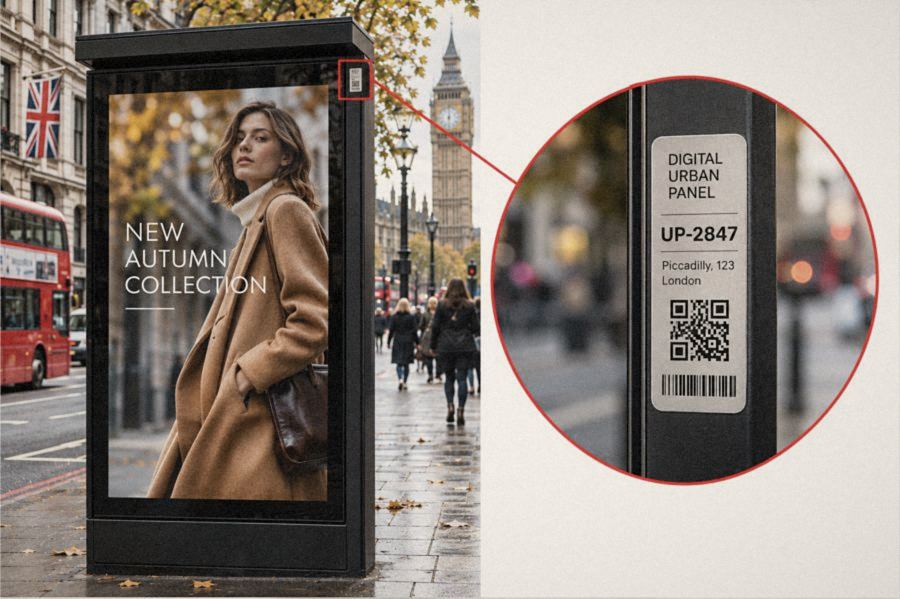

How out-of-home is split up in Spain
Out-of-home is one of the growing media in Spain. InfoAdex's 2026 study puts investment at €460.5 million in 2025, up 6.7% on the previous year and 7.3% of all measured media. Of that, €192.1 million was digital out-of-home and €268.4 million was classic out-of-home.1
Supply is highly fragmented. At the 2019 Out-of-Home Conference, Media Hotline presented a study that identified almost 150 media owners, 117 of which had filed accounts with the Companies Register since 2010. The largest, 4.3% of the total, accounted for 56.4% of investment, while the smallest 70% of companies shared 9.5%. The article reporting the study adds that the total number of media owners and sites is unknown.2 These are 2018 figures, the most detailed published data we have found on the structure of the sector.
Two years later, La FEDE-AEPE and OJD launched the medium's first geolocated inventory, which brought together 120,208 sites declared by ten companies.3 The rest of the supply, especially local media owners, sits outside that census.
Why that diversity helps planning
For the agency and the advertiser, having many media owners is an advantage. The large operators cover the main cities, street furniture, transport and airports. Regional and local media owners reach roads, mid-sized towns, shopping centres and specific settings where the brand needs to be. At the same 2019 conference, out-of-home was described as a medium spanning buses, street furniture and airports, "each with very different sites and formats".2
That is why a national Campaign with good coverage usually combines several media owners. The complexity comes later, when each of them enters the advertiser's and the agency's procurement and finance processes.
What multiplies with every media owner
Each media owner works with its own documents and terms, all reasonable on their own. Added together, they create a workload that grows with every new supplier. The contract sets its own creative deadlines, cancellation policy and approach to issues. Supplier onboarding means vetting the company, recording its tax and bank details and often checking its credit. The invoice arrives in its own format and with its own description, and has to be matched against the purchase order, the booking and what was actually posted.
That last step has a known cost. According to Ardent Partners' AP Metrics That Matter in 2025 report, processing an invoice costs $9.40 on average and takes 9.2 days, and that 14% of invoices need exception handling.4 These are cross-industry accounts payable averages. In out-of-home, a Campaign with several media owners multiplies the number of invoices, and every face with an issue can add a credit note.
| Task | With each media owner | With a shared process |
|---|---|---|
| Terms | One per contractCreative deadlines, cancellation and issue handling differ for each media owner. | SharedThe same operating rules for everyone; price is still agreed with each media owner. |
| Supplier onboarding | One per companyVetting, tax and bank details, credit check. | OnceThe shared counterparty is vetted. |
| Invoices | One format per issuerEach invoice with its own layout and description. | One formatE-invoice with the same structure, the Campaign code and a breakdown by face. |
| Proof of posting | Loose photosBy email or in folders, with different criteria. | LinkedPhoto, location and time tied to each booked face. |
| Payment | One term per supplierSeparate due dates and reconciliations. | Based on deliveryFunds are released when the agreed terms are met. |
| Counterparty risk | Spread outExposure to the solvency of every company in the chain. | ContainedThe Campaign's money is held by a regulated institution. |
Credit risk and concentration risk
In an out-of-home Campaign, money moves along a chain: the advertiser pays the agency and the agency pays each media owner. Every link bears the risk that the one before pays late, and the advertiser also bears the risk of paying for something that is not delivered as booked.
Payment terms in Spain widen that exposure. According to the Spanish Multisector Platform Against Late Payment (PMcM), the private sector paid at an average of 67 days in 2025, above the legal limit of 60, and 85% of the suppliers surveyed say that large companies pay well beyond the legal terms.5 For a local media owner, the invoice for a national Campaign can be a significant share of its quarter.
Faced with so many suppliers, procurement's usual response is to concentrate: work with a few large media owners to have fewer contracts, fewer onboardings and fewer invoices. That cuts the admin load, at the cost of narrowing planning options and relying on fewer suppliers. It is a familiar pattern in indirect procurement. Roland Berger estimates that tail suppliers typically make up 80% to 90% of a company's supplier base and around 20% of indirect spend.6 Out-of-home fits that pattern, with many small suppliers, each with little weight in total spend and the same handling cost as a large one.
A shared process and a shared counterparty
The alternative is to keep every media owner the plan needs and standardise how you work with them. The agency still plans with each one and agrees its price, and the media owner keeps its commercial relationship with the agency and the brand. The operation becomes shared. Inventory is described with the same taxonomy, proposal and contract follow the same flow, proof of posting arrives with the same data, invoices have the same structure and payment follows the same rules.
Procurement vets once and applies the same operating terms to everyone, and finance receives comparable invoices and reconciles them against delivery. Each Campaign's funds are held by a regulated institution and released to the media owner when the agreed terms are met. The advertiser pays for what was delivered and the media owner knows from the start that the money is there.
One process per media owner
- ContractOne per media owner, with its own terms
- OnboardingOne vetting per company
- InvoicesDifferent layouts and descriptions
- ReconciliationBy hand, against orders and photos
- PaymentOne term per supplier
One shared process
- InventoryThe same taxonomy for everyone
- BookingEach agency at its agreed price
- Proof of postingPhoto, GPS and time per face
- InvoiceLinked to what was delivered
- PaymentFunds held until the agreed terms are met
E-invoicing helps bring order to the process
Spain's Royal Decree 238/2026 makes e-invoicing mandatory between companies. Invoice recipients will have to report whether they accept or reject each invoice and the date of actual payment.7 The obligation starts on 6 October 2027 for companies turning over more than €8 million and on 6 October 2028 for everyone else.8
With every invoice in a structured format, the Campaign code and the breakdown by face fit as fields on the invoice itself, and procurement can require them from all media owners alike. We explain how to define that code in One code for every Campaign.
Where to start
- Count media owners and invoices for the last yearHow many out-of-home suppliers are set up, how many invoices they issued and how many involved issues or credit notes.
- Agree shared operating termsThe same creative deadlines, cancellation, proof of posting and issue rules for everyone. Price is still negotiated with each media owner.
- Ask for invoices with the same structureCampaign code, breakdown by face and period, and a reference to the proof of posting.
- Review your risk exposureHow much money is outstanding with each agency and media owner at any time, and how it is protected.
- Measure the processInvoices per Campaign, days to reconcile and share of faces with issues, to compare year on year.
Where OS.ooh fits
OS.ooh is the shared operating layer for agencies and media owners. Everyone's inventory uses the same taxonomy, each agency books at its agreed price and whatever is sold is locked, with no double bookings. Proof of posting arrives with photo, GPS and time linked to the Campaign, invoices are issued in Facturae from what was delivered and funds are held in an escrow account with MoneyToPay, an entity regulated by the Bank of Spain, and released when the agreed terms are met. Each company works with its own roles and permissions.
Sources
- InfoAdex, "Estudio InfoAdex de la Inversión Publicitaria en España 2026. Resumen", February 2026 (in Spanish). lafede (media.timtul.com)
- Reason Why, "¿Cómo podemos hacer crecer el medio Exterior?", on La FEDE-AEPE's Out-of-Home Conference and the Media Hotline study, 24 June 2019 (in Spanish). reasonwhy.es
- Reason Why, "Nace el primer inventario de publicidad exterior geolocalizado en España", 24 November 2021 (in Spanish). reasonwhy.es
- Apex Analytix, "Ardent Partners – Key AP Metrics That Matter in 2025", on Ardent Partners' AP Metrics That Matter in 2025 report, 12 March 2025. apexanalytix.com
- Forbes España, "El 85% de las grandes empresas incumple los plazos legales de pago, según PMcM", on the Plataforma Multisectorial contra la Morosidad report, 16 April 2026 (in Spanish). forbes.es
- Roland Berger, "Unlocking the hidden value in tail spend: How small moves create big impact", 22 April 2026. rolandberger.com
- EY, "El Gobierno aprueba el futuro sistema español de facturación electrónica", briefing, 9 April 2026 (in Spanish). ey.com
- EY, "El 6 de octubre de 2027 entra en vigor la facturación electrónica", briefing, October 2026 (in Spanish). ey.com