
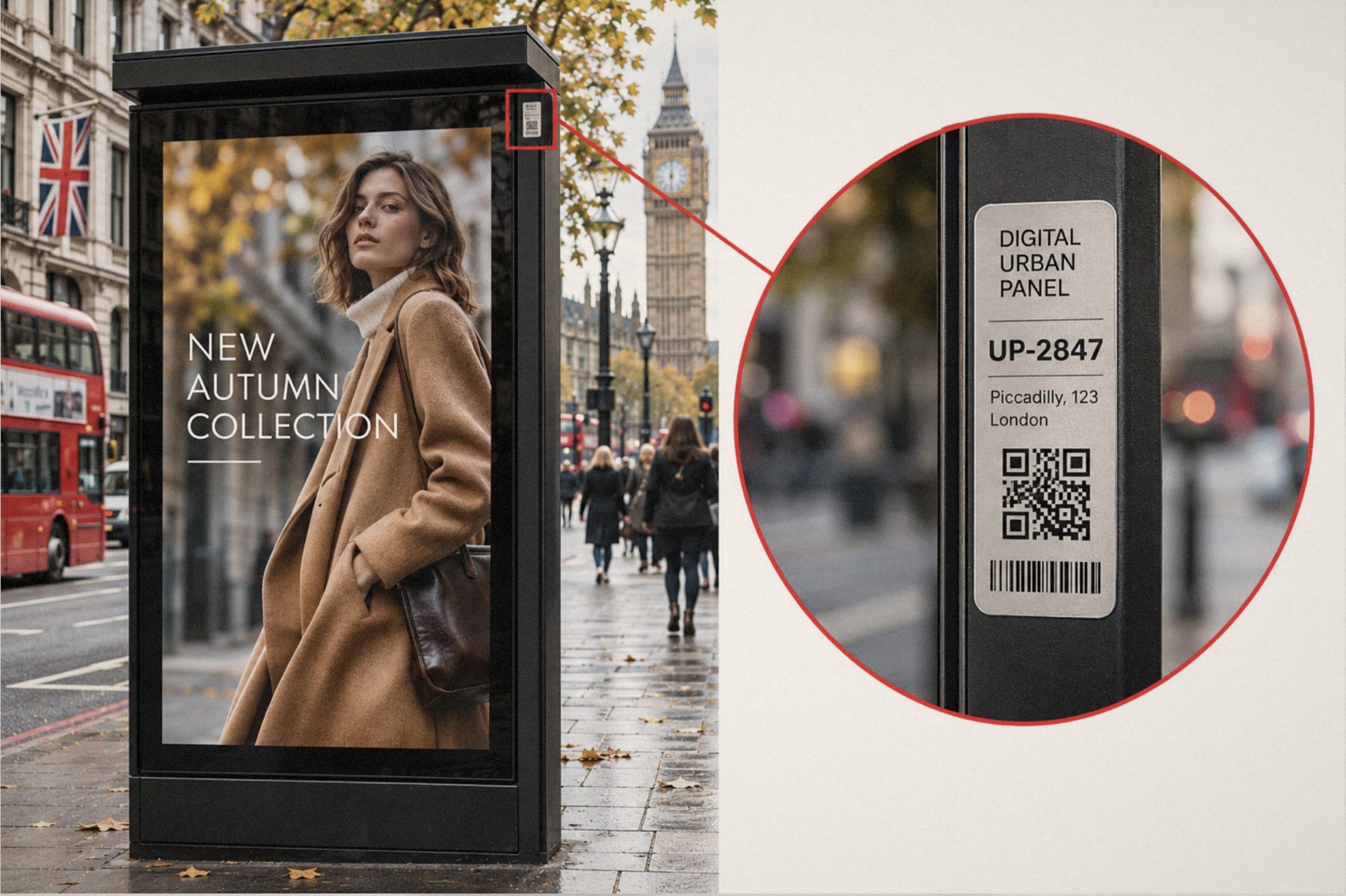
One Campaign, many names
An out-of-home Campaign involves the marketing team, the agency, procurement, several media owners, installers and finance. Each produces its own documents and names them by its own criteria. The plan talks about the "spring Campaign", procurement issues a numbered purchase order, each media owner invoices with its own description, proof of posting arrives in weekly folders and the report groups by quarter.
When someone needs to join it all up, for a report, for the marketing mix model or for an audit, they have to cross-reference the documents by hand. IAB's State of Data 2026 report notes that measurement teams spend a lot of time stitching scattered data together before they can analyse it.1
Spring CampaignPO-4471OOH March Madridphotos_week_12OOH Q1With a shared code
OOH-27-MAD-014OOH-27-MAD-014OOH-27-MAD-014OOH-27-MAD-014OOH-27-MAD-014A precedent: Ad-ID
In the US, Ad-ID is a registry that gives every ad a code, much as a barcode identifies a product, and that code links to the ad's data, such as title, length or product. The first characters belong to the advertiser and the rest identify the ad. It is run by a company owned by the 4A's, the agencies' association, and the ANA, the advertisers' association.2
Ad-ID identifies creative assets. Out-of-home would need something similar at Campaign level: a code assigned by the advertiser or its agency on approval that travels with every document produced afterwards.
What the code could look like
The advertiser can start on its own, without waiting for an industry standard. It only has to define a simple rule, share it with its agencies and suppliers and require it on every document. This is one possible format.
Whatever the format, three rules apply. The code is assigned once, when the Campaign is approved. It does not change even if dates or faces change. And it appears on every document, from proposal to payment.
Where it needs to appear
| Document | Who produces it | What the code is for |
|---|---|---|
| Media plan | Marketing and agency | Starting point: this is where it is assigned. |
| Purchase order | Advertiser's procurement | Linking the spending commitment to the Campaign. |
| Proposal and contract | Agency and media owners | Knowing which faces and terms belong to the Campaign. |
| Proof of posting | Installers | Tying each photo to the booked Campaign and face. |
| Invoices | Media owners and agency | Allocating spend to the Campaign without matching descriptions. |
| Report and mix model | Marketing and analytics | Relating investment, delivery and results. |
E-invoicing makes it easier
Spain's Royal Decree 238/2026, published in the Official State Gazette on 31 March, makes e-invoicing mandatory between companies. Invoice recipients will have to report acceptance or rejection, the due date and the actual payment with its date.3 The obligation starts on 6 October 2027 for companies turning over more than €8 million and on 6 October 2028 for everyone else.4
With structured invoices that include the actual payment date, the Campaign code lets finance trace out-of-home spend from the plan to payment, without relying on someone interpreting each invoice description. For the marketing leader, that means being able to answer with data how much each Campaign cost and when it was paid, as we explain in How to make the case for out-of-home investment with business data.
Where to start
- Agree the format with procurement and financeA simple rule that works for every medium, starting with out-of-home.
- Assign the code when each Campaign is approvedOnce, and without changing it if dates or faces change.
- Share it with agencies and media ownersAsk for it on proposals, contracts, proof of posting and invoices.
- Use it on the purchase orderTo link the spending commitment to the Campaign from the start.
- Check it in the report and the modelSo all of the Campaign's data can be filtered by the same code.
One identifier in OS.ooh
In OS.ooh, every Campaign has its identifier from the proposal onwards, and the contract, the proof of posting for each face and the invoices all keep it. Because everything is run in the same system, the code does not depend on someone copying it from one document to another.
Sources
- Inside Radio, "IAB finds ad models still undervalue audio", on IAB's State of Data 2026 report, 4 February 2026. insideradio.com
- Ad-ID, "About". ad-id.org
- EY, "El Gobierno aprueba el futuro sistema español de facturación electrónica", briefing, 9 April 2026 (in Spanish). ey.com
- EY, "El 6 de octubre de 2027 entra en vigor la facturación electrónica", briefing, October 2026 (in Spanish). ey.com