How each medium in the plan is managed
In digital media, buying happens on platforms that log every impression, results can be checked while the Campaign is live and third-party verification is part of the process. In digital out-of-home, every screen produces a play log, and in markets such as the UK those logs are brought together in a shared system that is audited every quarter.1
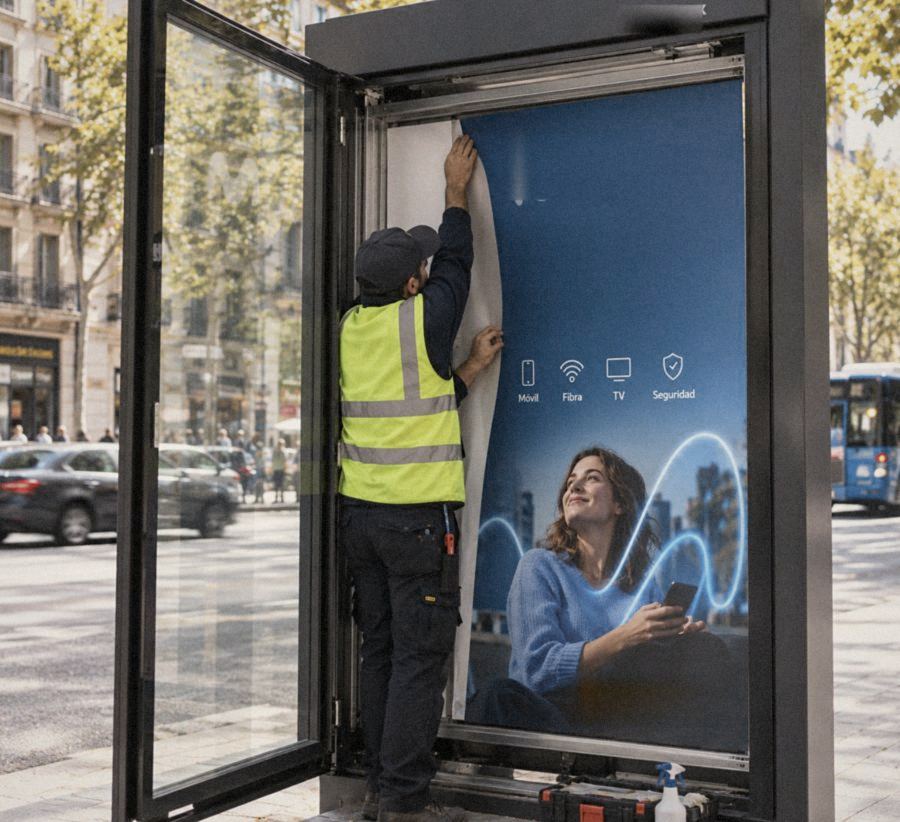
In static out-of-home, availability is checked by email, proof of posting arrives as photos and each media owner issues its own invoice. The UK has not solved this either, and the British industry body still lists proof of posting for static among its pending work.1 We cover this in more detail in How does a brand know its Campaign actually ran?
| Process | Digital | Digital out-of-home | Static out-of-home |
|---|---|---|---|
| Buying | SystemBuying platforms. | SystemProgrammatic or platform booking. | ManualAvailability and booking by email with each media owner. |
| Verification | SystemImpression logs and third-party verification. | SystemPlay log from each screen. | ManualInstaller photos by email. |
| Invoicing | SystemBased on delivery. | MixedBased on plays, per media owner. | ManualOne invoice per media owner, to reconcile against the booking. |
| Data for the model | ContinuousDaily and by area. | PartialBy screen, depending on the media owner. | ReconstructedFrom the plan and the invoices. |
What this means for advertisers
The gap shows at three moments. The first is the Campaign report, which in static out-of-home is put together once the Campaign has ended, as photos and invoices come in, while the rest of the plan is checked on a dashboard.
The second is the marketing mix model. In IAB's 2026 survey, 46% of model users consider out-of-home and other traditional media under-represented.2 Data reconstructed from the plan and the invoices enters the model weakly, as we explain in How to bring out-of-home into your marketing mix model.
The third is the conversation with finance. In the 2025 CMO Survey, 63% of US marketing leaders felt more pressure from the CFO,3 and in Gartner's 2026 survey 56% said their budget falls short of their strategy.4 At that level of scrutiny, a line whose data arrives late and in different formats is harder to defend. We go into this in How to make the case for out-of-home investment with business data.
A static out-of-home Campaign report is put together once photos and invoices have all arrived.
Of marketing mix model users see out-of-home and other traditional media as under-represented.
Of US marketing leaders felt more pressure from the CFO in 2025.
What bringing it up to standard means
Bringing out-of-home up to the standard of the rest of the plan has four parts. The Campaign is bought in a system where agency and media owner see the same information. Every face posted is verified with proof linked to the booking. The invoice comes from what was delivered, with issues already reflected. And the data is available by week and by area, with a shared Campaign code, for the report and for the model.
- BuyingProposal and contracting in a system shared by agency and media owner.
- Verified deliveryDated, geotagged proof for every face, linked to the booking.
- InvoiceGenerated from what was delivered, with issues deducted.
- DataBy week and by area, for the report and for the marketing mix model.
What to ask for in the next Campaign
These are five things a marketing leader can raise when preparing the next out-of-home Campaign, so the medium is managed like the rest of the plan.
- See the status of every face during the CampaignWithout having to ask by email.
- Receive verified deliveryWith dated, geotagged proof linked to the booking.
- Have the invoice reflect what was deliveredWith issues already deducted.
- Get the data by week and by areaWith a shared Campaign code in the plan, the invoice and the report.
- Add audience from the provider already in useConnected to the same system, with the same metric across Campaigns.
OS.ooh
OS.ooh is the infrastructure where agencies, media owners and installers run every out-of-home Campaign, from proposal to payment. For the advertiser, that means having buying, verified delivery, invoicing and out-of-home data in one system, with audience from the provider the agency chooses connected through an API.
Sources
- Outsmart, "Outsmart and Third Party Verification Statement", July 2026. outsmart.org.uk
- IAB and BWG Global, State of Data 2026, February 2026. iab.com (via MediaPost)
- Duke University Fuqua School of Business, "Marketing's strategic influence expands, as does scrutiny", on The CMO Survey 2025, April 2025. fuqua.duke.edu
- Gartner, "Gartner 2026 CMO Spend Survey finds CMOs allocate 15.3% of marketing budgets to AI but only 30% are ready to scale AI capabilities", 11 May 2026. gartner.com