What the three-way match is
It is a classic procurement control. Before paying an invoice, accounts payable checks that it matches the approved purchase order and the document showing that what was ordered has been received. Rockefeller University's purchasing procedure, for example, describes it this way: for goods processed through the receiving department, the signed receiving report, the purchase order and the supplier's invoice are compared, and payment is made only when they agree.1
The same procedure covers the other case. When there is no receiving report, as with services, consulting or repairs, a two-way match is carried out: purchase order against invoice.1 Out-of-home advertising is a service, and in practice it usually falls into that second case. The agency compares the media owner's invoice with its order, and the proof that the service was delivered, the photos, is reviewed separately and often after payment.
Mandatory e-invoicing in Spain will make this step more visible. Under Royal Decree 238/2026, invoice recipients will have to report whether they accept or reject each invoice, as well as its payment date.2 To accept on solid grounds, it pays to have matched the invoice beforehand against what was booked and delivered.
How it carries over to out-of-home
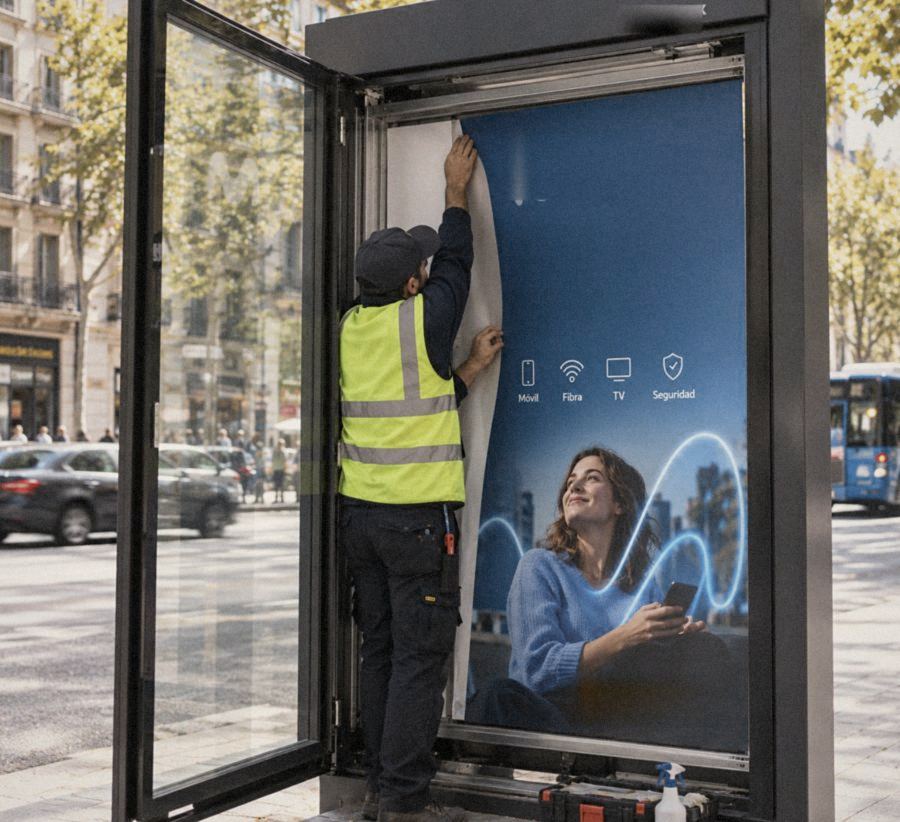
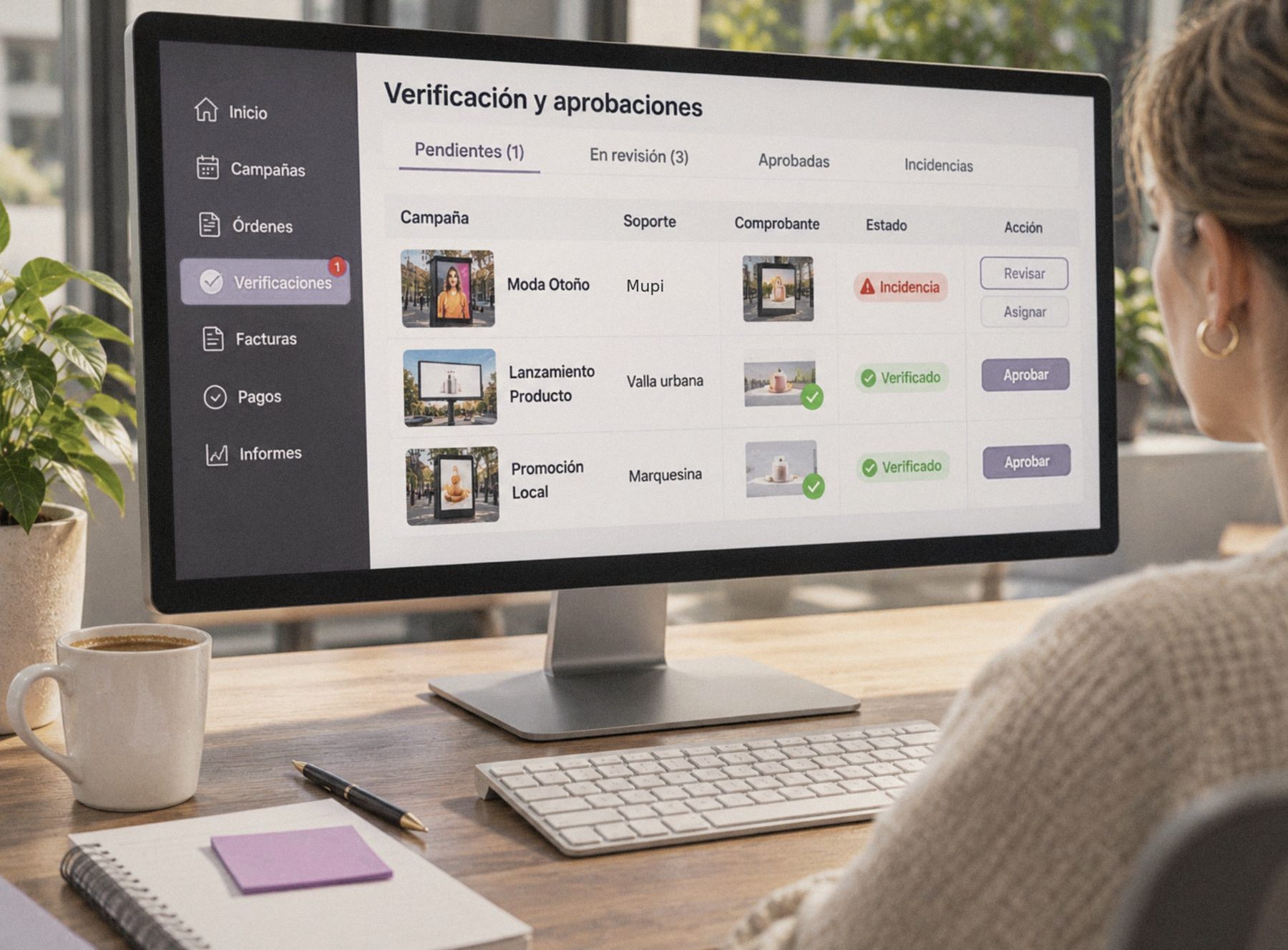
In an out-of-home Campaign, the three documents are the purchase order the agency sends to the media owner, the proof of posting for each face and the invoice. Each pair of documents answers a different check.
What each match checks
- Order and proofWhat was posted matches what was bookedEvery face on the order has a proof of posting, within dates and with the approved creative.
- Proof and invoiceOnly what was posted is billedEvery invoiced line corresponds to a face with a valid proof for that period.
- Order and invoicePrice, quantities and a single invoiceUnit price, number of faces and days as agreed, with no repeated lines or invoices.
The match protects in both directions. Towards the media owner, the agency pays for what was posted at the agreed price. Towards the client, it re-invoices only what it can prove, and avoids issuing credit notes weeks later when the client spots a missing face.
How often differences come up
There is no public statistic on exceptions in out-of-home invoices in Spain. As a general accounts payable reference, Ardent Partners' State of ePayables 2025 report gives these averages.3
of invoices have an exception that requires manual intervention.
is the average time to process an invoice.
of accounts payable staff time goes on handling supplier enquiries.
In out-of-home there is reason to think the share may be higher, because physical delivery problems come on top of price or quantity differences. In a review of fifteen Campaigns in Italy, almost 10% of billboards did not carry the booked ad.4 We covered this in How does a brand know its Campaign actually ran? Each agency can calculate its own rate with a simple figure: media owner invoices that needed correction, a credit note or clarification, divided by invoices received in the same period.
What an agent does in each check
If the order, proof of posting and invoices are linked to the same Campaign and to each face, the matching can be handed to an agent. The work is mechanical and repetitive: read each invoice line, find the face on the order, check that a valid proof of posting exists within the dates, compare price and quantities and look for repeated invoices or lines. The output is a proposal per line, approve or hold, with the evidence attached.
The decision stays with a person. Before starting, finance and operations need to agree the rules: which rounding differences are accepted, how many days of posting delay trigger a discount under the contract and who approves each type of exception. With those rules written down, the team reviews only the flagged lines.
| Discrepancy | How it is detected | What to do |
|---|---|---|
| Site not posted | The face is on the order and the invoice, with no proof of posting. | Hold lineRequest the proof or a credit note. Do not re-invoice that face to the client until resolved. |
| Posted outside the dates | The proof date is later than the booked start. | Adjust amountApply the discount or compensation the contract sets for the days without exposure. |
| Wrong creative | The photo does not match the creative approved for that face. | Hold lineRequest reposting and adjust the days under the contract. |
| Price differs from agreed | The invoice unit price does not match the order. | Request correctionReturn the invoice for correction and pay at the agreed price. |
| Different quantity or period | More faces or days are billed than appear on the order. | Pay what was orderedAccept only what was ordered and posted; any excess needs explicit approval. |
| Duplicate invoice | Same supplier, number and amount, or the same faces and period on two invoices. | Block paymentCancel the duplicate before paying and notify the media owner. |
| Invoice with no order | No Campaign order backs the invoice. | Hold invoiceRequest the Campaign reference and approval from the person responsible. |
| Issue during the Campaign | A follow-up proof shows the face damaged or covered. | Apply contractApply the agreed reposting or compensation and reflect it on the invoice and the re-invoice. |
What each side gains
Agency finance
- Pay for what was verified and hold only the lines with differences.
- Re-invoice the client with proof for every face.
- Accept or reject each e-invoice with a documented reason.
Media owners
- See the specific difference and its evidence as soon as it is detected.
- Get paid for the rest of the invoice without waiting for one line to be cleared.
- Receive fewer queries and claims at the end of each Campaign.
Where OS.ooh fits
In OS.ooh, the contracting of each Campaign, proof of posting with photo, GPS and time, and the Facturae invoice are linked to the same Campaign. What is sold is locked, with no double bookings, and funds are held in an escrow account with MoneyToPay, an entity regulated by the Bank of Spain, and released when the agreed terms are met. With that data in place, the three-way match can be automated for every invoice.
Sources
- The Rockefeller University, Materials Management, "Two-Way and Three-Way Matches". rockefeller.edu
- EY, "El Gobierno aprueba el futuro sistema español de facturación electrónica", briefing, 9 April 2026 (in Spanish). ey.com
- Ardent Partners, "State of ePayables (Part Nine): AP Benchmarks and Best-in-Class Performance", on The State of ePayables 2025: AP's Unfinished Journey, 22 January 2026. payablesplace.ardentpartners.com
- BeMyEye, "BeMyEye and Kinetic join forces to tackle OOH billboard compliance issues", case on Campaigns from the first half of 2016. bemyeye.com